

How do you say Anger in German?

Anger in German

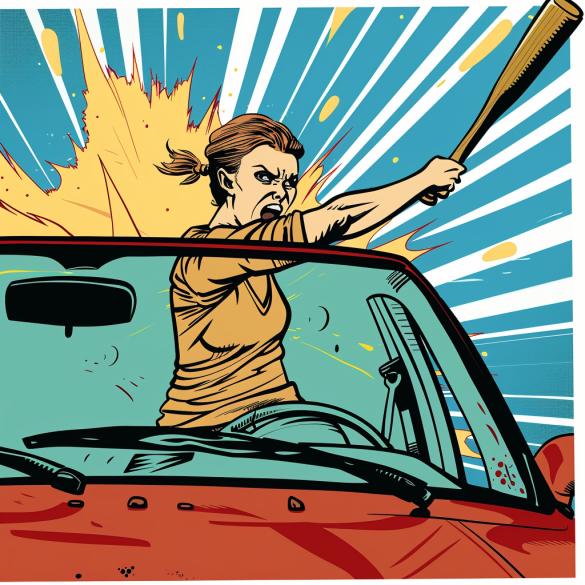
When someone’s face turns red, their voice shakes, and emotions boil over - Germans call it Wut. It’s not just mild annoyance; this is serious, unfiltered anger.

The noun Wut means anger,rage, fury, or wrath, and it’s one of the 1000 most frequently used nouns in German. You’ll hear it in personal arguments, political speeches, protest slogans, and emotional storytelling.

It’s a feminine noun, so we say die Wut.

Pronunciation

Wut is pronounced [voot].

  • The W is pronounced like V,
  • The u is like the “oo” in food,
  • One syllable, hard and sharp: voot

It sounds heavy and loaded - fitting for what it represents.

Example sentences:

  • Sie konnte ihre Wut kaum unterdrücken.She could barely hold back her rage.
  • Aus Wut warf er die Tür zu.He slammed the door in anger.

Nuance and usage tips

Wut refers to deep, emotional anger - not just irritation. It often implies loss of control, intensity, or eruption. Think fists clenched, shouting, crying, or trembling.

  1. Emotional contexts
    • Wut auf jemanden haben - to be furious at someone
    • Wutanfall - tantrum / fit of rage
    • Wutrede - angry rant or speech
  2. Social and political use
    • Volkswut - public outrage (a transparent compound)
      Volkszorn - public anger or outrage
    • Wutbürger - an angry citizen (often politically disillusioned, became popular in 2010s media)
  3. Repression and catharsis
    • unterdrückte Wut - suppressed rage
    • Wut rauslassen - to let the rage out

Related contrasts:

  • Ruhe means calm and
  • Gelassenheit means composure.
  • Vergebung means forgiveness; it can coexist with anger and is not a direct antonym.

Grammatical case examples:

  • Nominative:Die Wut stand ihm ins Gesicht geschrieben.The rage was written all over his face.
  • Accusative:Ich spürte die Wut in mir aufsteigen.I felt the rage rising inside me.
  • Dative:Mit der Wut kam auch die Traurigkeit.With the rage came the sadness.
  • Genitive:Wegen der Wut sagte sie Dinge, die sie später bereute.Because of the rage, she said things she later regretted.

Feminine case pattern: die, die, der, der

Word variations and language tidbits

Variation Station:

  • wütend - angry (adjective)
  • Wutanfall - tantrum or outburst
  • Wutrede - angry speech
  • Wutbürger - citizen driven by anger (often political)
  • Wutschrei - scream of rage
  • Wutentbrannt - seething with rage (used in narrative/literary German)

Fun idiomatic note:Germans will sometimes say:

„Ich bin vor Wut geplatzt.““I exploded with rage.”Or more playfully:„Ich könnte vor Wut die Wände hochgehen!““I could hit the roof!”

📘 Duden entry: https://www.duden.de/rechtschreibung/Wut

🎥 Learn Wut and the rest of the top 1000 German nouns in our free online video course:Watch the 1000 German Nouns video course

Alternate translations note:Ärger often means annoyance or irritation. Zorn means anger or wrath and can be intense; it is not a milder degree of irritation. In everyday speech, Ich bin sauer! means “I’m mad!”

Ready for more German words of the day? Do you know what Zauberer means? How about Zeichen? Find out!

Free download

Get the 1000 Most Frequently Used German Nouns ebook - free.

Leave your email and I’ll send you a link to the ebook. You’ll also get my occasional German-learning tips. No spam, unsubscribe anytime.


Keep reading.

Comments

Loading comments…

Comments appear after approval.