

21 December 2025
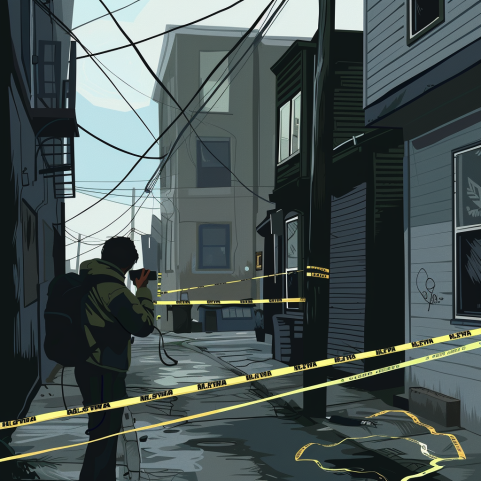
It’s where detectives investigate, where evidence is collected, and where stories often begin. In German, it’s der Tatort. This is your German word of the day, and it’s perfect for crime shows, police reports, or just chatting about what happened where.
The noun Tatort means crime scene, and it’s one of the 1000 most frequently used nouns in German. You’ll see it in the news, hear it in police dramas, and maybe even recognize it from Germany’s most famous TV show.
It’s a masculine noun, so we say der Tatort (struggling with German noun genders? Our video lesson will make it much easier to master).
Tatort is pronounced [TAHT-ort].
Tat - “taht,” with a long “ah,” as in “father”
Ort means “place,” pronounced like “ort” in “fort”
Stress is on the first syllable: TAT-ort
It sounds sharp and serious - just like its meaning.
Die Polizei sichert Spuren am Tatort.The police are collecting evidence at the crime scene.
Tatort Berlin: Ein neuer Fall für Kommissar Ritter.Crime scene Berlin: A new case for Inspector Ritter.
Tatort literally means “deed-place” (Tat = act, Ort = place). It’s used to describe the location where a crime took place.
Common phrases:
am Tatort - at the crime scene
Tatort untersuchen - investigate the scene
Tatortfoto - crime scene photo
Tatortreiniger - crime scene cleaner
Tatortbericht - crime scene report
Culturally, the word also has a second life…
Tatort is also the title of a long-running German-language TV crime series, strongly associated with Sunday evenings on public television. The episodes rotate between detective teams based in different German, Austrian and Swiss cities. It has been running since 1970.
If someone says:“Ich schaue Tatort.”They probably mean the show, not the scene of an actual crime.
In daily life:“Warst du am Tatort?” - Were you at the crime scene?“Die Straße wurde am Tatort gesperrt.” - The street was closed off at the scene.
In pop culture:“Der neue Tatort war spannend!” - The new Tatort episode was exciting!
It’s a word that’s both formal and familiar - depending on the context.
Timo: Hast du den neuen Tatort gesehen?Lea: Ja! Der Fall in Köln war richtig spannend.Timo: Ich mag die Kommissarin total.Lea: Ich auch - sie ist cool und clever.
Timo: Did you see the new Tatort?Lea: Yeah! The case in Cologne was really exciting.Timo: I really like the female inspector.Lea: Me too - she’s cool and clever.
Nominative:Der Tatort wurde weiträumig abgesperrt.The crime scene was cordoned off widely.
Accusative:Die Ermittler betraten den Tatort vorsichtig.The investigators entered the crime scene carefully.
Dative:Am Tatort wurden keine Zeugen gefunden.No witnesses were found at the crime scene.
Genitive:Die Analyse des Tatorts dauert an.The analysis of the crime scene is ongoing.
Masculine case pattern: der, den, dem, des
Related terms:
Tat - act or deed (esp. criminal)
Ort - place or location
Täter - perpetrator
Tatwaffe - weapon used in the crime
Tatzeit - time of the crime
Cultural note: Saying “Ich bin Tatort-Fan” in Germany can instantly spark conversation - especially on Monday mornings.
📘 Duden entry🎥 Want to investigate your way to better German? Our free video course teaches the top 1000 nouns - with examples, visuals, and grammar strategies that stick.
Ready for more German Words of the Day?Do you know what Tritt means? It could land with force - or just get you up the stairs.And what about Telefon? That one might still be ringing while you’re reading this.
Free download
Leave your email and I’ll send you a link to the ebook. You’ll also get my occasional German-learning tips. No spam, unsubscribe anytime.


Comments
Loading comments…