

21 December 2025
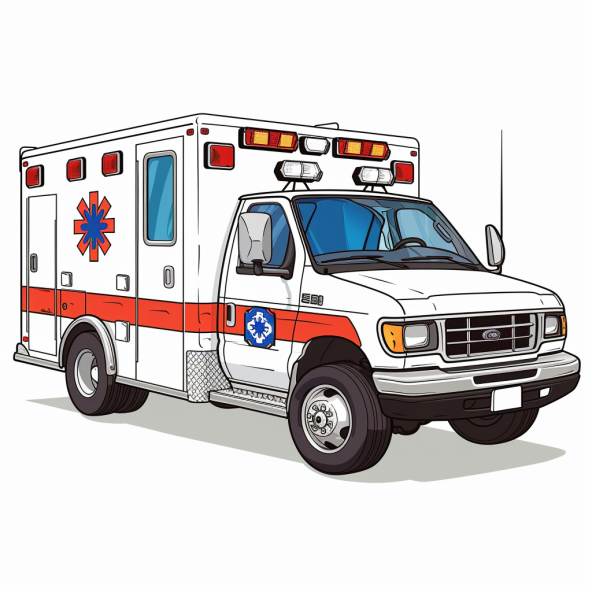
In real life, on the news, or even in movies, it’s a word you can’t avoid. If you’re learning German, knowing how to say ambulance in German gives you access to emergency vocabulary, health-related discussions, and helpful phrases for serious situations.
The word is Krankenwagen, pronounced /ˈkʁaŋkn̩ˌvaːɡn̩/. The a in krank is short; the a in Wagen is long. German w sounds like English v, and the g in Wagen is hard, as in “go.”
Krankenwagen is masculine, so it’s der Krankenwagen. The plural is die Krankenwagen. To better understand articles like der, die, and das, check out my gender video lesson.
It’s one of the 1000 most frequently used nouns in German, because it shows up everywhere - especially in real-life conversations and urgent contexts.
Dingsies are cute but very dumb. Guide them through the correct German words towards safety! The more you play, the better your German gets!
Examples in all four cases:
Nominative:
Der Krankenwagen kommt in fünf Minuten.
The ambulance will arrive in five minutes.
Accusative:
Ruf sofort einen Krankenwagen!
Call an ambulance right away!
Dative:
Sie wurde mit dem Krankenwagen ins Krankenhaus gebracht.
She was taken to the hospital in the ambulance.
Genitive:
Die Sirene des Krankenwagens war sehr laut.
The ambulance’s siren was very loud.
Real-World Tips for Learners
Krankenwagen is a compound word: Krank (sick) + Wagen (vehicle or cart). So literally, it means “vehicle for the sick.” Krankenwagen is an everyday word for an ambulance. In Germany, a Rettungswagen (RTW) is equipped for emergency care; a Krankentransportwagen (KTW) transports patients who need medical supervision without necessarily needing emergency treatment. For a medical emergency in Germany, call 112.
Useful phrases:
einen Krankenwagen rufen - to call an ambulance
mit dem Krankenwagen fahren - to ride in an ambulance
der Notruf - an emergency call; in Germany, dial 112 for medical emergencies and the fire service.
der Notarzt - an emergency physician; they may arrive in a separate Notarzteinsatzfahrzeug (NEF).
In everyday conversation, Krankenwagen often appears in news stories, emergency descriptions, or past experiences - like accidents or fainting spells.
Beginner dialogue using Krankenwagen:
A: Was ist passiert?
B: Jemand ist gestürzt. Wir brauchen einen Krankenwagen!
A: What happened?
B: Someone fell. We need an ambulance!
Now it’s your turn. Think of your answer and say it aloud using Krankenwagen.
“Hast du schon einmal einen Krankenwagen gerufen - oder bist du selbst darin gefahren?”
Have you ever called an ambulance - or ridden in one yourself?
Say your answer out loud in German and include Krankenwagen in the sentence.
Duden entry for “Krankenwagen”
Emergency vocabulary is one of those things you really want automatic, not “let me think” - Krankenwagen, Notarzt, Notaufnahme. A short daily round of German vocabulary practice is how you get there without memorizing flashcards for hours.
German Word of the Day
Now you know how to say ambulance in German - and how der Krankenwagen connects to real emergencies and practical speaking situations.
Download the free illustrated PDF of the 1000 most frequently used nouns in German and keep building your vocabulary for everyday confidence.
Ready for more German Words of the Day?
Check out Krankheit - essential for medical and emotional conversation.
Or revisit Krebs - a deep word with medical, astrological, and biological uses.
Free download
Leave your email and I’ll send you a link to the ebook. You’ll also get my occasional German-learning tips. No spam, unsubscribe anytime.


Comments
Loading comments…