

21 December 2025
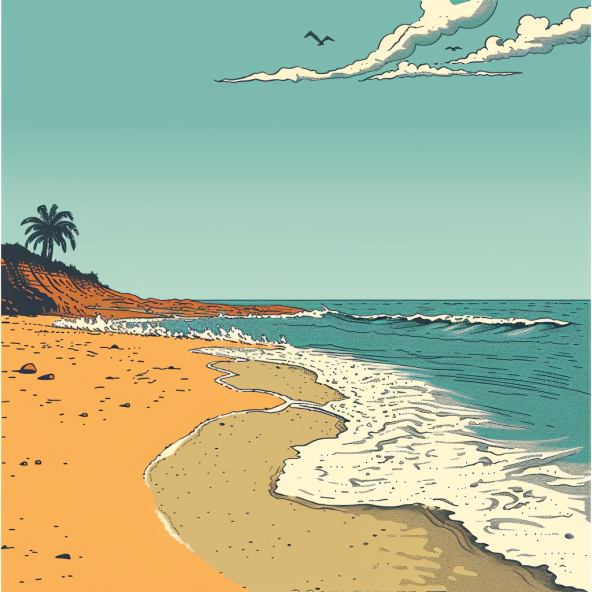
The German word for beach is der Strand.You’ll see it on signs by the coast, in weather reports, and in holiday conversations. Germans love the beach just as much as anyone - so if you’re headed to the Baltic Sea or a Mediterranean getaway, you’ll definitely hear it.
It’s one of the 1000 most frequently used nouns in German (get the free illustrated PDF!), and a must-have if you plan on ever packing sunscreen.
It’s a masculine noun: der Strand.Want to get a feel for gender patterns that stick? Check out our video lesson - it’s designed to help it all click.
Pronunciation:Strand is pronounced [shtrahnt]
Start with sht plus r; r pronunciation varies.
Short German a, then nt; final d sounds like t.One syllable: SHTRAHNT
Wir fahren morgen an den Strand.
We’re going to the beach tomorrow.
Der Strand ist heute voll.
The beach is crowded today.
Ich liebe Spaziergänge am Strand.
I love walks on the beach.
🏖️ Common combinations include Strandurlaub (beach vacation), Strandkorb (those hooded wicker beach chairs you see all over northern Germany), and Strandwetter (beach weather). In spoken German, people might say ab an den Strand! meaning something like “let’s hit the beach!”
🧴 A Strand can be sandy or pebbly, and swimming need not be possible. Küste means the broader coast, while Ufer means a bank or shore.
🌊 It also appears in compound nouns like Badestrand (swimming beach), Sandstrand (sandy beach), or Strandpromenade (beachside promenade).
“Wo ist der schönste Strand hier?”
Where’s the nicest beach around here?
“Hast du deinen Strandkorb schon reserviert?”
Have you already reserved your beach chair?
“Am Strand ist es heute super windig.”
It’s really windy at the beach today.
Emma: Hast du Lust, morgen an den Strand zu fahren?Jonas: Klar! Ich pack meine Badesachen ein.Emma: Bring auch Sonnencreme mit.Jonas: Und vielleicht ein paar Snacks für den Tag?
Translation:Emma: Want to go to the beach tomorrow?Jonas: Sure! I’ll pack my swim stuff.Emma: Bring sunscreen too.Jonas: And maybe some snacks for the day?
Nominative:Der Strand ist sauber und ruhig.
The beach is clean and quiet.
Accusative:Wir gehen an den Strand.
We’re going to the beach.
Dative:Ich liege gern am Strand.
I like lying on the beach.
Genitive:Die Farbe des Strandes verändert sich bei Sonnenuntergang.
The color of the beach changes at sunset.
While Strand is the most direct and common word for beach in German, there are other words you might come across. Ufer refers more broadly to a riverbank or shoreline. Küste means “coast” or “coastline” and is often used for scenic descriptions like die raue Nordseeküste. If someone says Seeufer, they’re talking specifically about a lakeshore, not an oceanfront. These alternatives tend to describe geography more than recreation, so stick with Strand for beach vacations and sunny getaways.
You’ll often see Strand show up in compound nouns like Strandurlaub (beach vacation), Strandbar (beach bar), and Strandspaziergang (walk on the beach). There’s even Strandgut, a word for flotsam or material washed ashore - stuff washed up on the beach. Germans often say things like ein echter Traumstrand for “a dream beach,” or Strandwetter when the forecast is just right.
🧠 Fun fact: While Germany doesn’t have tropical beaches, it has a surprisingly strong beach culture - especially along the North and Baltic Seas. The iconic Strandkorb (beach chair) was invented in Germany in 1882 and is still a staple of northern coastal resorts today.
📘 Duden entry for Strand🎥 Want to build a strong foundation in German? Our free video course teaches the top 1000 nouns - with pronunciation, examples, and real-life context.
Ready for more German Words of the Day?Do you know what Stück means? You’ll want a Stück of this vocab to take on the world.And what about Stress? It tends to follow you - even on vacation.
Free download
Leave your email and I’ll send you a link to the ebook. You’ll also get my occasional German-learning tips. No spam, unsubscribe anytime.


Comments
Loading comments…