

21 December 2025
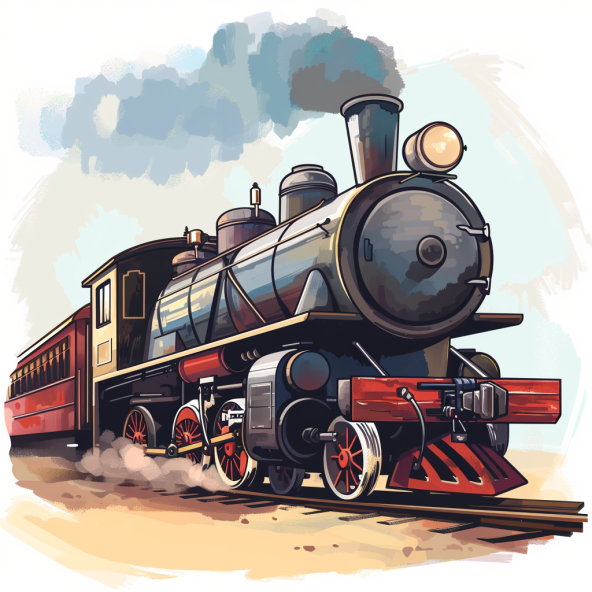
Whether it’s barreling down the tracks, advancing across a chessboard, or just taking a deep breath - Germans call it a Zug. It’s a strong, punchy word that’s all about movement and direction.
The noun Zug most commonly means train, but also pull, move, draft, or stroke, depending on context. It’s one of the 1000 most frequently used nouns in German, and it shows up in travel, games, physiology, and mechanics.
It’s a masculine noun, so we say der Zug.
Zug is pronounced approximately [tsook], with long u and final k.
It sounds like what it is - powerful, direct, and always moving.
Example sentences:
Zug comes from the verb ziehen (to pull), and it can mean many things depending on the context:
Related contrasts:
Masculine case pattern: der, den, dem, des
Variation Station:
Fun idiomatic note:A useful figurative word:
„Sie ist das Zugpferd der Partei.““She’s the party’s big draw.”A Zugpferd (literally “draft horse”) is the person or product that pulls in the crowds. And in den letzten Zügen liegen means “to be on one’s last legs.”
📘 Duden entry: https://www.duden.de/rechtschreibung/Zug
🎥 Learn Zug and the rest of the top 1000 German nouns in our free online video course:Watch the 1000 German Nouns video course
Alternate translations note:For train as in a series of connected things (like thoughts or events), Germans might say Reihe or Abfolge. But for rail transport, board games, a pull on a rope, or a lungful of air - Zug is the versatile, powerful word you need.Ready for more German words of the day? Do you know what Zunge means? How about Zukunft? Find out!
Free download
Leave your email and I’ll send you a link to the ebook. You’ll also get my occasional German-learning tips. No spam, unsubscribe anytime.


Comments
Loading comments…