
3 February 2026

Why most courses are teaching you the hard way - and why learning German through English actually works.
I’ll never forget something our English teacher told us back in high school.(I went to a bilingual German-American school, for context.)
“It’s so silly that we’re forbidden from using a language we already know to our advantage when learning another.”
And he was right.
Years later, I found myself observing a new teacher in a language school I was working at - I was shocked to see him spend two full minutes miming and circumscribing the word “Satellit.” Drawing orbits in the air, pointing at the sky, making rocket noises - trying everything to communicate the idea before he finally realized almost every student in the room had a word like satellite in their native tongue already.
So frustrating. So inefficient. But this kind of thing is completely normal.Because in most German language classes, teachers aren’t allowed to use any language except German.
It’s baked into the system - especially in the massive, state-funded integration courses. These classes are built for large groups of people from all over the world - often without a single shared reference language. So teachers are trained to teach in only German, from day one. They’re not just discouraged from using English. They’re forbidden.
And even though that makes some sense in a mixed-language classroom, it makes zero sense when you do speak English.
But this “immersion at all costs” mindset has become the default method - even in courses made for English speakers. Even in apps. Even in private lessons. And it’s holding learners back.
At Deutschable, we do the opposite.We teach German through English. Because it’s the fastest, clearest, and smartest way to learn - especially if you’re an analytical learner who likes to understand why something works before being expected to use it.
Would you use a mysterious machine you know nothing about? Probably not. You’d want someone to show you what each button does - in a language you understand.Why should learning a language be any different?
Let’s look at why English as a reference language isn’t just a helpful tool.It’s a total game changer.
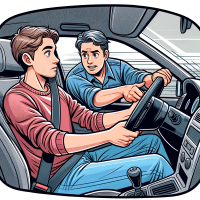
Learning German as an English speaker isn’t like learning a completely foreign skill. It’s like switching from automatic to manual.
Sure, there’s new stuff to learn - clutch timing, gear shifting. But you already know how a car works. You understand roads, rules, braking, acceleration. You’re not starting from zero.
Immersion teaching ignores that and makes you pretend you’ve never been behind the wheel before. It wastes your time showing you “Brot” and “Apfel” as if you’ve never heard the words “bread” or “apple” before. It forces you to rediscover grammar concepts you’ve already internalized.
German through English honors your prior knowledge. It treats you like an intelligent person who just needs a good map - and not like someone stumbling through a dark room hoping to bump into fluency by accident. (Source)

Immersion learning expects you to “feel” grammar through repetition. But then it corrects you harshly for making mistakes in rules you were never taught. It’s like being quizzed on algebra when no one explained the formula.
Here’s how we do it instead:
So:“Das Brot ist für den Bäcker.”Boom.
No guesswork. No confusion. Just grammar that clicks - because it’s explained through the language you already speak.

English speakers don’t need an entire lesson on what a house is.They don’t need ten minutes to understand “a” vs. “the.”
But because standard programs are designed for the lowest common denominator in mixed-language classrooms, everyone is taught everything from scratch, regardless of background.
If you already know the concepts, why sit through explanations meant for someone who doesn’t?
German through English gives you what you need, not what someone else might need. That means faster progress, less repetition, and a whole lot less boredom.

Immersion expects you to figure it out as you go, but then penalizes you when you don’t. That’s a terrible way to learn.
Let’s say you say the wrong pronoun in a sentence. A teacher might just correct you. But that doesn’t help unless you understand why.
English already gives you the framework:
But unless someone tells you that - in English - you’ll just keep guessing.
Most people aren’t bad at grammar. They just haven’t been taught it in a way that makes sense. That’s exactly what our 2-hour grammar course does: it explains everything clearly, in English, even if you “don’t get grammar.” And once you do? The whole language opens up.

Let’s be clear: you do want to get to the point where you can think in German, speak in German, live in German. That’s the goal.
Just like a stick-shift driver eventually needs to drive over the Alps.
But that shouldn’t be your first drive.
You should start on a quiet side street, with a teacher next to you explaining how the pedals work. You should have a sense of what’s going on before you’re navigating hairpin turns.
The same goes for language. Immersion works best once you already have the tools to notice patterns, understand corrections, and absorb what you’re hearing.
It’s like training for a half-marathon: a coach who explains your form, hydration, nutrition, and recovery makes the training more effective - even if you’re not thinking about those things during the actual run.
The “why” doesn’t slow you down. It gets you there faster.
Sure - some people thrive in pure immersion. They don’t want explanations. They don’t care about grammar. That’s fine. But for everyone else, for the analytical thinkers, the fast learners, the curious minds who like to know how something works?
German through English is the obvious choice.
Every Deutschable lesson is about five minutes long. But because we explain things through English, you actually get it the first time.
You don’t have to rewind. You don’t have to look up grammar tables. You don’t have to guess.
That’s why our learners see real progress within days - not weeks.It’s not about studying harder. It’s about being taught smarter.

One common teaching method is parroting:
Useful phrases - but totally inflexible.
What happens when you want tea? Or three teas? Or no coffee, but still something to eat?
That’s the problem with phrasebook learning. It’s rigid. You only know what you’ve been given. The moment the situation changes, you’re lost.
But when you learn how German sentences work, explained in English, those sentences become templates. You can swap in new vocabulary. Rearrange structure. Adapt to real-life conversations.
It’s freeing. And suddenly, immersion becomes a joy - because you’re surrounded by a language that finally makes sense.

If you’ve ever watched a bilingual or trilingual child learn a new language, you’ve probably noticed how fast they connect dots. It’s not because their brains are magically different - it’s because they already have reference points.
They hear something in the new language and link it back to something they already know. It’s not about translation - it’s about anchoring. Reinforcing. Creating neural pathways that say, “Oh, this is like that.”
That’s exactly what German through English does for you. It gives your brain handles - ways to grip new vocabulary, structures, and sounds. Not just floating concepts, but clear parallels and pathways.
And the best part? This approach mimics how multilingual minds naturally learn. By comparing. By connecting. And by making meaning instead of memorizing.
So even if you’re not a bilingual child - you can still learn like one. (Source)

A lot of people assume every German teacher knows how to explain grammar, compare structures, and identify what students need.
But that’s often not the case.
Why? Because many teachers were trained in pedagogy, not linguistics. They’re taught how to run lessons - but not how to break down how German works. And even the ones who do know how? Often aren’t allowed to use English anyway.
That means even the best-intentioned teachers end up teaching to the lowest common denominator - or relying on repetition and guesswork instead of clarity.
The difference with Deutschable is that we start from what English speakers already know. We anticipate confusion before it happens. We teach the language, not just the lesson.
We don’t just tell you what to say. We show you how and why it works, so you can actually own the language - and use it in the real world.
Let’s clear this up right now:You don’t need perfect English. You don’t need a British passport. You don’t need to know what “past perfect progressive” means.
You just need to speak English conversationally.
That’s enough to use it as a bridge to German - because this method works by comparison. And if you understand a few simple English grammar terms (don’t worry - we’ll explain them), you’ll get it.
In fact, thousands of learners around the world use English as their go-to reference language when learning German - not because it’s perfect, but because it’s shared.It’s the one language they feel comfortable enough in to understand explanations.That’s what makes it powerful.
If you can read this blog post, you can learn German through English. And you’ll do it faster, smarter, and with far fewer headaches.
Here’s the truth: your brain learns best when it has context.When it understands the “why.”When it’s not overwhelmed by guesswork or bogged down by abstract rules.
That’s why German through English works so well. It’s not about coddling. It’s about clarity.
So - where to begin?
📘 Download our free 1000 German nouns ebook. It’s packed with high-context images, smart English translations, and only the words you’ll actually use.⏱️ If you’re starting out or looking for a crystal-clear refresher, try our Five-Minute A1 German course. It’s ideal for beginners and even better for people who’ve already done A2 but still feel shaky on the basics.
🎓 Then, take our 2-hour grammar course. It’s made just for English speakers - even those with no grammar background - and will change the way you think about German forever.
Whatever you do, have fun and don’t forget that it’s ok to use English 🙂 Shout out to my old English teacher! (Mr. McC., if you’re reading this, why did you unfriend me on Facebook? I thought we were cool!)
Be sure to check out my related post: How to Effectively Learn German Words (for English Speakers)
Free download
Leave your email and I’ll send you a link to the ebook. You’ll also get my occasional German-learning tips. No spam, unsubscribe anytime.

Comments
Loading comments…